Monday, 8 January 2018

Etymology Excavation: fascinating

First seen on the Space Trash Blog.

What is etymology, and why are you excavating it?

Etymology is like the archeology of a language (definition: the study of the origin of words and the way in which their meanings have changed throughout history).

In this series of posts, we're going to look at some of the English phrases, like 'at full tilt', 'toe the line', 'when push comes to shove' that are commonly used, and have an interesting history - and that people often get wrong.


Well, I haven't done an etymology excavation in quite some time, and it occurred to me that now would be a good time, because I recently found out where the word 'fascinating' comes from...or at least, I think I have, and it's epic.

So why 'fascinating'? Usually I look at phrases, where they come from, how they could be adapted to fiction, how they often get misused...well, I reckon actually that you may be misusing 'fascinating' without even knowing it.

Fascinate is originally from the Latin half of the English language, from fascinare. Feel free to run that through a few web searches, but originally to bewitch (or to hex, curse), to irresistibly attract, and also to deceive or to obfuscate (hide). You can see how that set of meanings vaguely relate to each other.

So that's what the origin word meant, and how it got used down through today, when it's used pretty much interchangeably with 'interesting'.

However, I put it to you that fascinate shouldn't actually be used as a conversation-stopper when whats-his-face will not STFU about whatever...fascinate deserves much better than that, and here's why: I feel there is a solid argument to be made that fascinate, and fascinare, come from the name of an ancient Roman deity, Fascinus.

If you're thinking that a fascinum amulet looks startlingly akin to a donger with wings on, well, you aren't wrong. Ancient Romans, eh. Very similar to modern culture in so, so many ways...

But long story short, unless whatever you're saying is fascinating is at least as good as a flying penis that wards off the evil eye, you're probably using it wrong and blaspheming to boot.

Saturday, 6 January 2018

How do I get started writing?

First seen on the Space Trash Blog.

Get started writing - how?

Every writers' forum I've spent time in has had someone, sometime, show up asking 'how do I get started writing?' At this point I always find myself needing to take my hands off my keys and wrestle down a sarcastic response like 'Start typing'.

After a few months of feeling vaguely guilty every time the situation occurred, it came to me that while the question that kept triggering my sarcasm reflex was a dumb one, there were possibly a few underlying questions more worth offering time to.

Ignoring the fact that some people really do show up on forums and ask stupid questions simply for attention, writing a book can be overwhelming. Here are some thinking points to make it more overwhelming.


Hubble, bubble, boil and trouble

If I were to write a 101 Guide to Getting Started Writing, some twenty years of fiction writing later, I'd have to say that there are a few vital ingredients that need to be tossed in the pot if you hope to make the magic happen.
  • A dash of crazy.
    • No sane person decides to write a book, spends a year or so of their lives writing, editing, and formatting it, and does all this knowing full well that they'll never get paid for their time.
  • A heaping teaspoon of inspiration.
    • You're crazier than I am if you'll waste months or a year of time for no remuneration and without something to write about that gets your blood pumping, whether it's space battles or how to come up with the perfect hall decor.
  • A solid dose of grammatical understanding (substitute a silly amount of money here if you have it).
    • If you can't be bothered to learn or look up basic grammar and punctuation rules for your language of choice, or don't want to pay someone who does to edit your work, stop writing now and back away from the manuscript slowly. There's a difference between idiot savant and idiot.


What genre should I write?

Doesn't matter, it's not catching.

If you have a good story to tell, it doesn't matter if it's about terraforming Mars or a half-siren 'acquisitions specialist' being paid to acquire the Peaches of Immortality. Good story-telling never goes out of style. On the topic of trying to follow writing 'fads', check out 'Writing Myths: slay the dragon'.

I know someone who manages to mix sci-fi, steampunk, and fantasy and I can't put their books down. I also know someone who invented the entire genre of elfrotica.

If you want to know more about genres of writing, I suggest you pull up a search engine and dig in. Wikipedia is always a good place to start. If someone's harassing you to come out of the writing closet as a certain genre, I suggest smiling sweetly and telling them that you aspire to be original.


But which writing house will the Sorting Hat put me in?

Writers tend to gravitate to one end or other of a spectrum that ranges from 'pantser' at one end to 'plotter' at the other. Read on to discover which school of writing wizardry best suits you.

To avoid any embarrassing misconceptions, it may be important to note at this point that 'pantser' in this context refers to one who flies by the seat of their pants. It does not necessarily relate to their state of dress or undress whilst engaged in the practice of writing.

You may be a pantser if you have voices in your head, a setting, and no idea in the world how it's all going to end, but you can't stop thinking about it and you've already had detention for drawing spaceships in class.

You may be a plotter if you have a ton of post-it notes arranged in careful patterns on your wall, detailing the main idea, the sub-ideas, the plot arc, the chapter beats, the sub-arcs (with the kinky bits inserted on the hot pink notes) and have a file on your protagonist detailed down to their first word and the exact position of the mole on their arse.

Which is best? That's the great thing - there is no 'best'. There's the approach that works for you, and the others, which don't. Most people fall somewhere in between.


Give me facts! I cannot make bricks without clay!

The fact is that the amount of actual money to be made from writing hit rock bottom about a decade ago and then started burrowing. Think I'm kidding? These guys did the math: The Authors' Guild - The Wages of Writing.

Additionally, traditional publishing houses are taking on fewer and fewer new authors, while trumpeting ever louder that independent authors, or 'indies' are the leeches on the underbelly of professional writing. Therefore, starting to write books with the idea that fame and fortune await is delusional, so you'd better have another reason for doing it (see the heaping teaspoon requirement).

If those facts haven't put you off, then at least you've got the dash of crazy. Congratulations (...I think).


So how will I know if I'm doing it right?

Assassin: "Where other men blindly follow the truth, remember..."

Initiate: "Nothing is true."

Assassin: "Where other men are limited by morality or law, remember..."

Initiate: "Everything is permitted."

This quote is particularly applicable to writing. The way I do it won't be the way you do it. The way J. K. Rowling does it will be different from both of us. None of the three of us is 'wrong'. Some people use a pencil, others touch-type at 100 WPM, others again dictate to voice conversion software.

Write whatever way blows your skirt up. There is no set of commandments. The only restrictions are your imagination and your writing ability.

Saturday, 2 December 2017

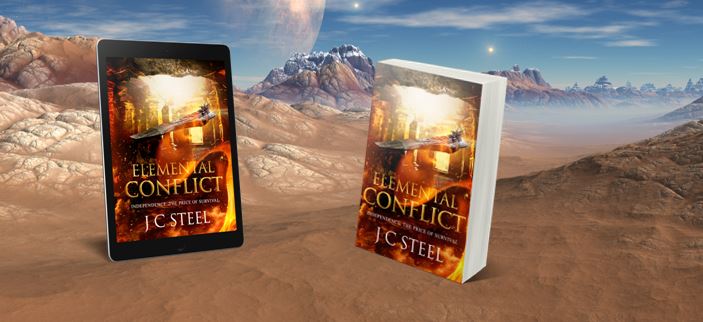
Elemental Conflict release day!

First seen on the Space Trash blog.

There's a question I like to ask other authors, and it's 'Would you live in the world you've created?' A lot of people - more than I expected, if I'm honest - say 'No way, José.'

Being contrary by nature, I absolutely would live in the world I've created. Admittedly, I might not live very long in it.

It's finally release day for Elemental Conflict, and I'm a little bit mindblown. Exhausted, happy, and staring at a row of four books attached to my name, which feels distinctly surreal.

Writing is my daily dose of escapism, and my sci-fi world is where I go when I day-dream. it's something I enjoy enough to still do after a long day in a stressful job and an hour or so stuck in commute hell. I may not work out, I may not stop long enough to cook healthily, but most days I'll make at least some time to write.

So release day is always a moment of combined 'Huh. Did I do that?' and 'Damn, it's over...' That latter sentiment is what always founders my good intentions to go and actually tell people that I released a new book - as soon as I switch on my computer, I get promptly shanghaied into starting the next book.

So, before I go and write more (yes, it already happened) of the next in the series...go and make a starving, exhausted author very happy and check out Elemental Conflict. It's up on pretty much every major book e-tailer for your reading pleasure ;)

Friday, 20 October 2017

Chapter Quotes

First seen on the Space Trash Blog.

Why add chapter quotes? Where do you get your chapter quotes from? Aren't chapter quotes hell to format?


Me, personally, I enjoy chapter quotes. Dorothy Dunnett, Seanan McGuire, and of course Frank Herbert are all awesome examples. If you've never read any of these authors, don't tell me because I will get very judgy.


"Facts are a commonly accepted interpretation. Truth is a commonly argued fiction." A Planet's Philsophy, Ankara Zaneth (From book 8...yes, I'm way ahead of myself.)

They're an insight into the world backdrop, a good laugh, or a context-setter, depending on what the author is doing with them and with their book. I put them in because, well, I'm a pure pantser. I don't outline. I generally have no idea what my characters are likely to do once I've dropped them into a scene. I find out when I write it down. As you can imagine, therefore, I usually end up writing my chapter quotes well after the fact. They're actually help me in the editing stage, because they act as a kind of focus mechanism for me when I'm editing a chapter. I can stare at the chapter quote for a bit when I get stuck, remember the awesome thing I was trying to do in that chapter, and return to hacking and slashing motivated and refocused. (Hah.) At least, that's how it sometimes works.
"Modesty is like arsenic: safe only in small doses." Sayings of the Wise, Olar Fantoml

As I kind of gave away in the last bit, I don't get my chapter quotes from anywhere. I make them all up. My father, who had very serious tastes in most of his reading, and considered sci-fi to be an extreme form of escapism, never actually read any of my books - but he would steal them from my mother when she was reading them, and he would read my chapter quotes. I still regret that I never really asked him why, because I think the answer would have been interesting.
"Avoidance requires continuous effort. Confrontation merely requires standing still." ~ Universal Truths, Jahira Suran

And yes, sometimes, depending on the platform, chapter quotes can indeed be hell to format. Kobo, for example, thinks my chapter quotes are a whole separate page unless I spend hours tickling it with an ostrich feather while immersing it in chocolate. (Kidding. I had to get much kinkier than that.)
"Training is not a substitute for experience; it is merely easier to survive." Training of a Cortiian, Nadhiri Longar (Yeah, Book 8 again...working on it.)

As to what my chapter quotes are supposed to achieve other than providing a focal point for my edits - I mostly leave that up to the reader. If they're something that you just skip on your way to the main events, no worries. If they make you grin, or start an interesting train of thought, then I'm happy. I frankly suspect most of mine actually come from Khyria's choices of reading matter. Most of them are downright cynical and sound like the kinds of things she'd remember.

Monday, 16 October 2017

Writing Myths that need slaying

First seen on the Space Trash Blog.

Writing Myths that need slaying

I must write something other people will like and approve of.


No. A thousand times no. As Oscar Wilde put it “You can always judge a man by the quality of his enemies.” Write your truth. If it pleases everyone, chances are high you’re doing something wrong. Offend people. Make them think. Challenge their beliefs. Challenge your own. The world is too full of people tiptoeing carefully through their existences without ever standing up for themselves or what they believe in. If everyone is comfortable with your words, you’re using the wrong ones.

I must write at a level everyone will understand.


Don’t insult the intelligence of your readers. Don’t be complicit in the dumbing-down of society. Write to the level that your book demands and your characters dictate. If you have a story able to reach out and grab your readers by the balls, they will find themselves a dictionary if they have to. Don’t lessen your work or yourself to please the masses - because often the ‘m’ is silent.

I must write something that will sell.


Why? Are there writers who seriously go in expecting to get rich from their work? Write what pleases you, because the trending genre this month will have blown away with the autumn leaves next month. Write what pleases you, because forcing yourself

to write what everyone else does will be a brutal exercise in boredom. If no one else is ever to read your magnum opus, you had best make certain it enthralls you. Be original. Be yourself. No one else can be.

Writing is a slog, a chore. Writing is like giving yourself homework every night for the rest of your life.


Writing is an adventure. Every time you pick up a pen, sit at a keyboard, you create a world that only you can; live for a while with the only people you’re willing to invite inside your head. Writing is an addiction and a cure. Writing is an antidote to the tedium of life that was the same today as it was yesterday, as it will be tomorrow. Writing should make your heart beat faster and the hair stand up on the back of your neck. Writing should be what gets you through the things you 'have' to do; the thing that wakes you up in the night with the next scene more alive in your head than the walls around you.

Wednesday, 19 July 2017

Character Interview: Anst an Nabat

First seen on the Space Trash Blog.

A Cortiian and an author sit on the side of a large fountain... (not the start of a bad joke)


J C Steel: Nice touch of paranoia.

Anst an Nabat: It's a nice fountain. Care to tell me why I'm here?

JCS: I take it Khyria delegated.

AAN: She mentioned something about this being an assignment I should be able to handle alone.

JCS: Ouch. One unarmed human asking questions. Nice burn. I told her the people who read our stories like sound-bites. Interviews. You're who turned up.

AAN: ...Interviews. Not that I don't enjoy your company, but what am I going to tell you that isn't already in one of the books? I've lost count of how many indiscreet confessions you must be privy to by now.

JCS: It's a thing. Not a thing I really understand, but what I understand about book marketing could go on the back of a postage stamp and leave lots of room. Try this one: what does Cantara rank mean, in the Cortii?

AAN: Seriously? A Cantara commands five riders, or a Canta. They report directly to the Cortiora when the whole Cortia is present, or operate independently when necessary.

JCS: And the Cortiora and Cortertia technically also command Cantai of their own, right? Any special roles within that structure?

AAN: Cortiora holds overall command. Cortertia is second in command, and traditionally responsible for information-gathering. It's not a hard and fast rule. Third Cantara mostly takes responsibility for standard training and evaluations. Fourth Cantara tends to be the social one - generally something like this would be a Fourth Cantara's problem. Fifth Cantara is flexible. Often mission requisitions, supplies, and stray bureaucracy.

JCS: What's the oddest thing about Earth, to you, Anst?

AAN: Do you want the list alphabetically? ... I assume you don't mean the things it has in common with almost every other human-governed world I've seen. Probably the levels of environmental damage. Even the most over-populated Central Worlds would be surprised by the scale.

JCS: So you'd be even more surprised to hear that there's a sizeable amount of the population that prefers to believe that man-made environmental damage is a myth.

AAN: Actually, denial is common human trait, so no, not particularly.

JCS: Favourite Earth food to eat?

AAN: Roquefort cheese. It'd be considered a biological hazard on more advanced worlds, so I can honestly say it's got a unique taste.

JCS: ...could you have picked something a little harder to spell? Not a question. Can you tell me something about your name?

AAN: It was computer-assigned when I was recruited, based on my ID code. It sounds Kihali, but Hejj'in's a big swathe of space.

JCS: Any plans to go?

AAN: To Hejj'in? It's a long way from FPA space. I'm more curious about Atari, if I were planning to spend a lot of a leave on a space liner.

JCS: Why Atari?

AAN: It's not FPA space, there are some interesting stories about Atari worlds, I haven't been there yet - pick one.

JCS: Favourite thing to do in your free time?

AAN: Be transported halfway across the galaxy for a chat about cheese.

JCS: ...arsehole. Anything else?

AAN: I enjoy riding. Horses tend to be undemanding company.

JCS: Anyone taking bets yet on when or if someone's going to make first move for an official First Contact on Earth?

AAN: I'm sure they are, but anyone with a standard lifespan isn't likely to be around to collect. The Nasdari and the FPA are unusually unanimous on letting someone else step in on this planet.

JCS: What are the main concerns for an alien government?

AAN: There's a list. Geo-political instability, if I had to guess, would be near the top. You've got a lot of little countries, and no real single place where a First Contact team could set down without being shot at, or where negotiations could begin without offending some other minor government. The shooting wouldn't worry the Nasdari, but stopping it would take time and credits with no real return on investment in sight.

JCS: Right. Is anyone else likely to step in?

AAN: Not that we know of, but the universe is a big place. The more likely alternate scenario is that you bomb yourselves out of existence and both the FPA and the Nasdari blow thrusters trying to stake a claim first.

JCS: Hah. Yeah, that scenario is amassing more and more voters. What fact about the Cortii do you think would surprise most humans?

AAN: ...sometimes I can go minutes at a time without planning how to kill them.

JCS: Funny. Try this one: what do you think about the way your character is written in the series?

AAN: I'm really not that narcissistic. You probably write me as more patient than I actually am.

JCS: OK, poor choice of question. What do you think of how the Cortii in general are written?

AAN: Given how very few facts we can let you actually publish, I'd say you've captured it with a certain nasty accuracy.

JCS: What do you think of writing, as an art form?

AAN: It's not one I'm very familiar with. If anything I do ends up written down, it tends to be reports. Cortiians in general tend towards more physical art forms, if they practice one at all. I'm getting to the point where I can appreciate what you do, but reading as a pastime isn't something I'd be likely to indulge in on Base.

JCS: Speaking of, I'm not too sure on interview protocol, but standard North American attention span is currently rated at about 6 seconds, so we'd better wrap this up.

Sunday, 16 July 2017

Cortiian Word of the week: Akrushkar

First seen on the Space Trash Blog.

Akrushkar, pl. akrushkari

The akrushkari come up a lot in the books based on the Cortiian Base. They're the Councils' enforcers, bodyguards, and most of the rank and file of the Cortii know almost nothing about them beyond their function. Think of them as military police with a tendency to shoot first and ask questions never.

The word comes from old Cortiian, based on krushkar, or slave - one without free will. You'll see the 'a' prefix in a lot of Cortiian words as well, like 'asra', 'as’sri’atan’si' - it's a submission prefix, an acquiescence.

So essentially 'akrushkar' means a slave obedient to orders. In this case, to the Councils that command the Cortii, who make a lot of despots look like underachievers. Because an akrushkar acts under the direct orders of the Councils, or, under a very limited set of circumstances, a Cortiora, they're essentially untouchable - raising a hand to an akrushkar is defying the Councils, and the fact that their personal bodyguards are called slaves should give you an idea of the Councils' views on disobedience.

To understand the akrushkari a little better, let's take a side-trip and examine the Councils for moment. Two levels to this structure: Inner Council, all five of them, and Outer Council, traditionally twenty. Outer Council numbers, unlike Inner, can vary, although it's rare. You'll note the Cortiian preference for fives running right through the command structure.

If you're on the ball, you'll already have realised that new Council members, or magaii, must come from somewhere. The Councils recruit from the top units on their Bases; Cortii who've reached Blue rank or higher, and the Councils are only open, by invitation, to Cortiorai.

So if a Cortiora accepts a place on the Outer Council, what happens to their command? There are a lot of rumours on Cortiian Bases, but the information isn't made common knowledge, and new appointments to Council happen so rarely that most Cortiians simply don't know.

However, the answer is simple and very practical: the Councils can't risk having high-calibre mercenaries roaming around loose with a powerful link to a magai.

Some are offered the honour of a place among the akrushkari, and undergo intense telepathic conditioning as well as memory blocks. Others end up as fodder for the Councils' experimental labs. A very few of the really lucky ones are assigned as solo agents somewhere that their Base needs long-term eyes. Some wind up as Instructors, also after having their memories edited. It ensures that no magai has ties to a serving unit, and that no Cortiian likely to ever spend time on Base again has any potential hold on a magai.

What happens to the Cortiora who accepts a place on Council, of course, is something only known to the Councils. No one has ever successfully infiltrated the Councils.